
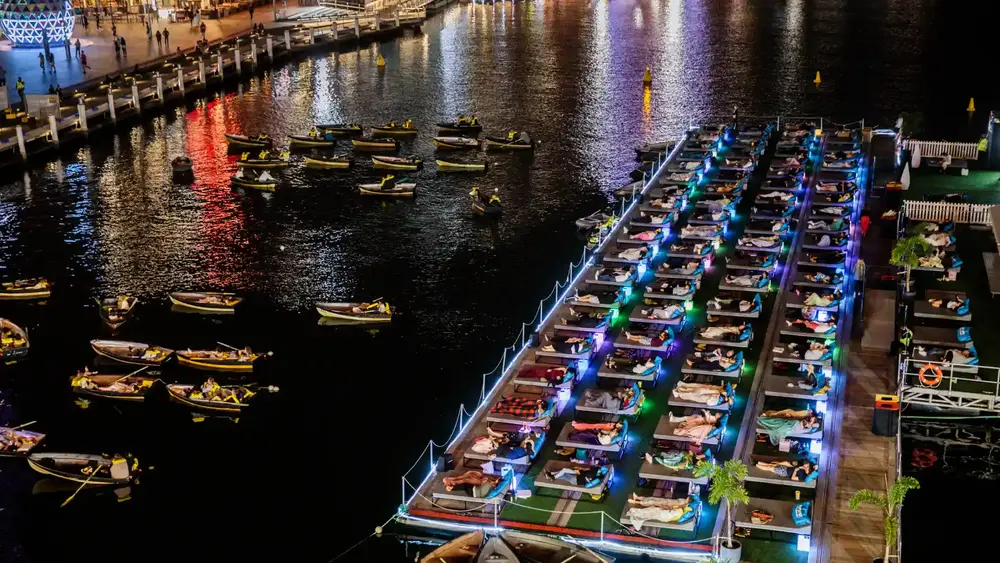
A boat show isn't like other events. You're not just gathering people on a platform. You're bringing vessels alongside, you're hosting exhibitors and buyers, you're creating a marketplace on water.
Your floating infrastructure needs to support that activity — safely, professionally, and with enough sophistication that exhibitors and buyers feel they're at a premium event.
Here's what separates adequate boat show infrastructure from infrastructure that actually works.
What Boat Shows Need From Floating Infrastructure
Boat shows have unique demands that most floating platforms aren't built for. Vessel berthing. You've got boats moored alongside your platforms. Sailboats, powerboats, catamarans — some displacing 5+ tonnes. These aren't people stepping onto a platform. These are substantial vessels that need secure, shock-absorbing mooring points. Safe boarding. Guests move between vessels and platforms constantly. You need safe, stable access that accommodates elderly guests, children, and people unfamiliar with being on boats. Weight distribution. A modern catamaran displacing 8 tonnes berthing alongside a platform creates loads that some platforms can't handle. Your infrastructure needs to handle dynamic loads — boats moving with waves, people boarding and disembarking. Protection. Your platforms need to protect both the vessels and the platforms themselves. You don't want boats bashing against pontoon edges. You need fenders (protective bumpers) and bumper systems that absorb impact without damage. Power and water access. Exhibitors need power for lighting, sound, information displays. They often need water for galley setups and toilet facilities. Your platform needs utilities, not just a flat space. Clarity and wayfinding. A boat show is a marketplace. Guests need to know where to go, what's on each vessel, which exhibitor is where. Your platforms need signage, lighting, and logical flow that guides people naturally. Boat shows that nail these elements feel professional. Boat shows that cut corners feel sketchy.
Berthing and Display Pontoons
Boat show infrastructure typically includes two types of platforms. Display pontoons are where the boats are moored. These are larger, heavy-duty platforms designed to accept moored vessels alongside. Display pontoons are typically 15m–30m long, 8m–12m wide, and engineered for loads of 100–200 tonnes depending on size. A typical 15m x 10m display pontoon can safely handle 3–4 boats moored alongside simultaneously, depending on vessel size. The pontoon itself becomes the exhibition space — signage, lighting, and information displays are mounted on the pontoon structure. Guests walk the pontoon perimeter to view the boats. Visitor platforms are adjacent areas where guests congregate, meet sales staff, and move between display areas. These don't have vessels moored alongside — they're pedestrian gathering spaces connected via walkways to display pontoons. A well-designed boat show layout alternates display and visitor platforms, creating a natural flow: guests walk the visitor platform, they see boats moored alongside display pontoons, they step onto a display pontoon to interact with sales staff and view the boat up close, they return to the visitor platform and move to the next display.
VIP and Hospitality Platforms
Boat shows often include VIP areas — lounges for serious buyers, media, sponsors, and exhibitor guests. VIP platforms are separate from the main show flow. They're quieter, they offer views of the water and the boats, and they provide hospitality: beverages, seating, often catering. A VIP platform might have 20–50 seats, a bar, restroom facilities, and premium finishes compared to the main show platform. VIP platforms also serve a logistical function. Serious buyers and dealers want a private space to conduct business. VIP platforms provide that — a quieter setting away from foot traffic where conversations can happen. Cost-wise, VIP platforms add $2,000–$4,000 to event costs depending on size, but they're a revenue driver. Premium exhibitors pay extra for VIP access, and they're willing to pay. VIP experiences also justify higher ticket prices for guests.
Load Requirements for Heavy Vessels
This is where infrastructure planning gets technical. A small sailboat (20–30 feet) displaces 3–5 tonnes. A modern cruising catamaran (40+ feet) displaces 12–25 tonnes. A performance speedboat (30–40 feet) displaces 8–15 tonnes. When a vessel moors alongside your platform, it's not a static load. It's a dynamic load — the vessel bobs with waves, it sways in wind, people board and disembark. The mooring lines keep it in place, but the platform feels the movement. Your platform needs to: Accept the load. A display pontoon accepting a 15-tonne catamaran alongside needs to be engineered to distribute that load across its flotation. Under-engineered pontoons will list (tilt) when heavy vessels moor alongside, which is unsafe and looks terrible. Absorb shock loads. Vessels moving with waves create shock loads as they tug against mooring lines. Your mooring points need to absorb that energy. Mooring cleats and hardware need to be robust — not the standard deck cleats on a regular pontoon, but heavy-duty marine-grade cleats rated for shock loads. Fender systems. You'll install fenders (rubberized bumpers) along the platform edge to prevent vessels from directly striking the pontoon. Good fender systems reduce shock loads, protect both the vessel and the platform, and make the mooring experience safer. Mooring redundancy. You're not relying on a single mooring line. A 15-tonne catamaran moors with 2–3 lines, often with backup lines, so if one fails the vessel doesn't drift. Most standard pontoons aren't designed for this level of load. You need purpose-built display pontoons if you're expecting vessels heavier than 8–10 tonnes.
Access Ramps and Walkways
Guest flow at boat shows is constant: people moving from display to display, vendors moving inventory, emergency personnel needing access. Articulated ramps connect platforms and rise/fall with tides. A good articulated ramp is non-slip (critical — wet surfaces are slippery), clearly marked, and sized so people can comfortably move across without feeling unbalanced. Handrails are essential. Guests include elderly people, young children, and people unfamiliar with boat environments. Handrails give them confidence. Lighting. If your boat show runs into dusk or evening, you need adequate lighting on platforms and ramps so people see steps, edges, and potential hazards. Lighting is also part of the ambiance — good lighting makes a boat show feel premium. Wayfinding and signage. Guests need clear direction. Signage showing "Vessel 1: Sailboat — 30ft Cruiser," "Vessel 2: Catamaran — 42ft Performance," etc. Directory maps showing which exhibitors are where. Pricing and ticketing information clearly posted.
MDE's Boat Show Experience
We've designed and operated boat show infrastructure for years. We've learned what works and what creates problems. We understand vessel mooring. We know how to safely moor vessels of different sizes and types. We spec fenders, mooring systems, and pontoon engineering correctly. We design for guest experience. Flow, wayfinding, accessibility. We think about how 500 or 1,000 guests actually move through a boat show, and we design platforms and ramps to support that flow. We manage exhibitor logistics. Boat shows need coordination between exhibitors, their vessels, utilities, signage, and access. We handle that coordination so the show runs smoothly. We've got proven infrastructure. We maintain display pontoons, visitor platforms, ramps, mooring systems, and safety equipment that are designed for boat shows. We don't improvise — we deploy proven systems. We handle permits and Coast Guard coordination. Boat shows involve vessels, water, public gathering. We manage the regulatory side so you can focus on the event.
Final Thoughts
Boat shows succeed when your floating infrastructure is designed for boats, not just for crowds. Proper berthing, robust mooring systems, safe access, and professional presentation all matter. Planning a boat show? MDE Projects has the experience and equipment. Call us today. We'll discuss your exhibitor needs, your vessel types, and your guest count — and recommend infrastructure that works.
Ready to Get Started?
Planning a boat show? MDE Projects has the experience and equipment. Call us today.